
Zingle
My words.
In their context.
I struggled to remember English vocabulary from isolated word lists. So I designed and built Zingle: a way to learn words through content I actually wanted to understand, then carry that context into review and writing.
01 A PERSONAL STARTING POINT
I needed my vocabulary, not another ready-made list.
Learning English meant learning words. But memorising a word on its own did not help me retain it or recognise how to use it. Many apps offered vocabulary chosen for me. Tools that let me add my own words often made that process feel too cumbersome.
I wanted to study through material that matched my interests and needs. The starting point was personal: keep the word connected to the moment it made sense, instead of copying it into another disconnected list.
02 TWO WAYS IN
Start with something worth reading.
The MVP needed a useful starting point for people who already had material, and for people who did not know what to choose yet.
A starting point at the learner’s level.
Level-based English stories let someone begin without first finding and preparing their own content.
Bring something personally relevant.
My Library lets learners add their own material. The import flow offers text, files, URLs, and audio, so the learning experience can start from content the person already cares about.
03 THE CONNECTION THAT MATTERED
Keep the sentence attached to the word.
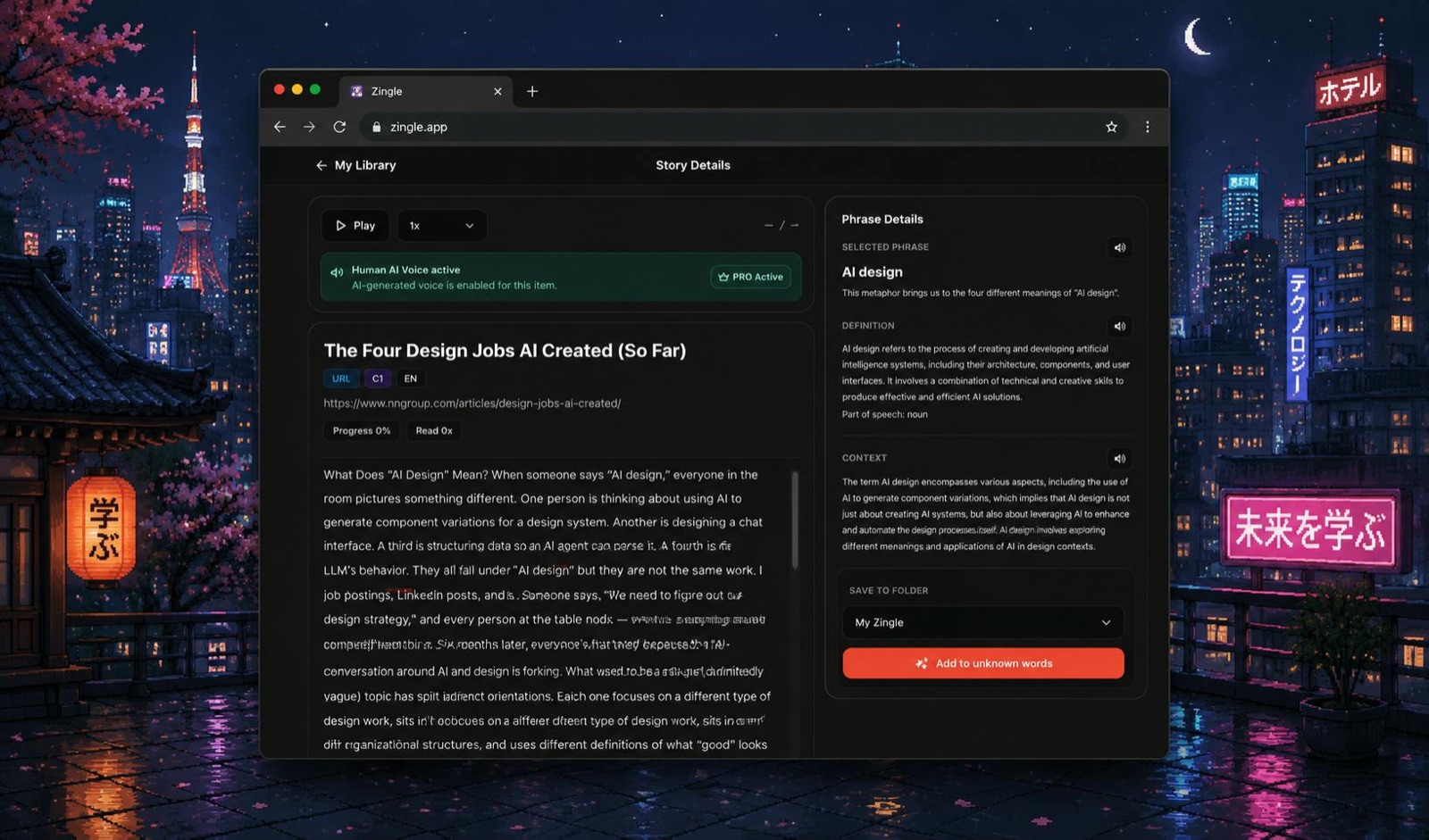
In Read Box, a learner can read or listen, choose an unfamiliar word, and get an explanation in the context of that passage. Selecting a phrase has its own explicit explanation action. The learner can then save the item to Word Box.
The original sentence remains part of the learning item. A definition explains what a word can mean; the source sentence explains why it meant that here.
- Encounter a word while reading.The learner starts inside a story or their own material.
- Understand that use.The explanation stays beside the passage, with meaning, usage, and audio support.
- Save it without losing its origin.The word and its context remain connected for later study.
04 A CONNECTED LEARNING LOOP
Recognition was only the beginning.
Saving a definition did not finish the job. Word Box keeps the learning detail available, while spaced review brings words back for recall. Write Box adds another step: working with sentences from the material.
Read
Encounter it in content.
Understand
Explain the meaning here.
Save
Keep word and sentence together.
Review
Recall, then rate the difficulty.
Write
Practise the sentence from memory.
In the writing flow, the learner first reads a sentence, then starts practice. The sentence is hidden while they type from memory. They can compare their attempt with the original and retry.
05 AN MVP WITH BOUNDARIES
Ship the learning path before expanding the inputs.
I kept the released experience focused on English stories and learners’ own content. A complete set of learning experiences for additional languages was not part of this version.
Personal content and an English starting point.
My Library, level-based English stories, contextual vocabulary support, saved words, review, and writing formed the connected experience.
Video-led learning and broader language coverage.
I had not shipped the idea of pausing a YouTube video and learning directly from its subtitles. More languages also remained future work rather than a claim of complete support.
06 FROM DESIGNER TO MAKER
I owned the product decisions and the implementation.
I designed, developed, and made the product decisions for Zingle myself. The initial MVP took about three months. Working across both design and development meant I also had to decide what belonged in the first release.
The responsibility extended from the learner-facing web app to its admin dashboard. I took the experience from design through implementation and release, then responded to the problems people found.
07 THE FIRST PUBLIC LAUNCH
The first week brought people beyond my own use case.
I launched Zingle on Product Hunt without paid promotion. I recall approximately 60 signups on the first day and 100 by the end of the first week.
Those numbers were an early acquisition signal. They did not establish retention or prove an improvement in learning.
Signup counts are approximate; the historical #13 rank is my account of launch week. The current Product Hunt listing displays #18.
08 QUESTIONS FROM OTHER LEARNERS
People asked whether their context would survive.
Public comments asked about retaining the source sentence in review, using professional material, and support for Portuguese and Turkish. Those questions helped make the product’s boundaries more explicit.
The original sentence was part of the value.
Learners wanted saved vocabulary to remain connected to the material they had read. This reinforced the reason for linking content, saved words, and review.
A request was not a released feature.
Interest in more languages became input for future work. I kept that separate from the English experience already available.
People also reported product and security issues. Responding to those reports became part of the work after launch.
Read the original launch discussion ↗09 WHAT I TOOK AWAY
A word is more useful when its context travels with it.
Zingle began with a problem I had myself. Shipping it turned that personal need into a product other people could question, use, and help improve.
The central design decision was to connect the steps. Reading supplies the context. Explanation helps with the immediate question. Saving preserves it. Review and writing give the learner a reason to return to it.
The first launch showed interest in that direction. Whether it becomes a lasting study habit needs longer-term evidence, beyond signup counts and a launch-day ranking.